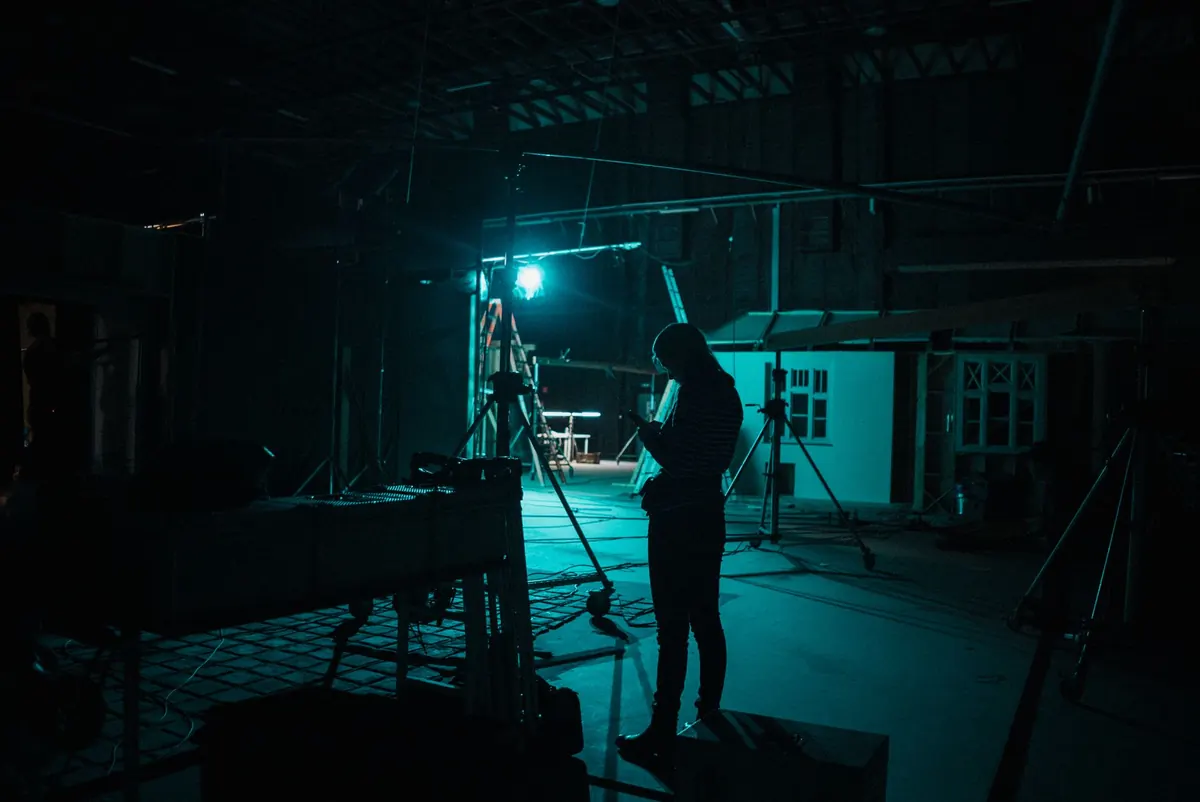
The first time someone hands you a headset and says “standby,” the theatre stops being a place you visit and becomes a place you work. It is also the moment you become capable of breaking something that six weeks of rehearsal built — not through malice, but through a crossed sightline, a slammed door, a whispered question at the wrong second. Most backstage mistakes are small. They are also entirely avoidable, and almost nobody explains them until after you have made one. Here are the rules working crews actually live by.
Stand in the front row of the house during tech, if the stage manager allows it, and look at the set from there. You will see gaps you did not know existed: the slice of backstage visible between two flats, the wings visible past the proscenium leg, the floor visible under the rail. Everything you do backstage is potentially visible from somewhere in that room.
Rule 1: Never cross a sightline. To get from stage left to stage right, walk behind the set. If there is no behind, cross low and dark, timed to a moment of stage business or a sound cue — never on a line an actor is delivering into silence. Never walk between an actor and the audience, however briefly. “Briefly” is how long it takes a phone to ring.
Rule 2: Learn the dark. Before the first performance, walk your backstage route with the working light off, at performance pace. Count the steps. Find the edge of the rake, the corner of the prop table, the cable you will trip over. Know which floorboards creak and tape what needs taping before someone else’s ankle finds it.
Spike marks are not decoration. If a chair is spiked, the chair goes back on the spike. The ghost light stays where it is — it is there so nobody walks into a dark stage and off the front of it.
Sound travels backstage in ways that surprise new crew. A whisper in the wings carries to the front row on a quiet night. A zip, a velcro rip, a dropped pin, a water bottle, a coin in a pocket — the audience hears all of it, and hears it as part of the play.
Rule 3: Don’t talk during the show, and don’t shush either. A loud “shhh” is often noisier than whatever it was meant to stop. Use the flat-hand signal, mouth the words, or wait. If you genuinely must speak, do it on the headset to someone who expects to hear from you.
Rule 4: Your phone does not belong in the room. Silent is not enough — a vibration on a wooden table is a drum, and a screen lights up a face. Airplane mode, screen off, in a bag, out of the wings.
Soft soles. Keys left in the dressing room. Doors closed with a hand on the frame instead of a slam. Small courtesies, enormous difference.
The headset is a private line that a dozen people share, and during a show it is a cueing system. Learn the vocabulary in your first week:
Rule 5: Keep the channel clear during the performance. Tech week is for conversation; the show is not. Don’t key up to breathe, don’t eat on channel, and mute before you cough. If you need to sneeze, take the headset off first.
Rule 6: Wait for your cue. Anticipation is the most common new-crew mistake. A light cue that goes two seconds early is worse than one that goes a beat late. Watch the stage manager’s hand, not your own instinct.
A quick change is not a scramble. It is a two-person manoeuvre rehearsed in advance, and the dresser leads it.
Rule 7: Stay where you were placed. That spot was chosen because the dresser can reach you and the audience cannot see you. Don’t wander off looking for better light.
Rule 8: Offer, don’t grab. Hands open, palms up, arms slightly out. Don’t help with the zip unless you have been asked, and don’t turn a sleeve inside out pulling at it. When a dresser says “breathe out,” breathe out.
Rule 9: Preset your own next cue. The next look laid out in dressing order — shoes open at the heel, fastenings undone, jewellery counted. Velcro and magnets instead of pins wherever the costume allows. Nothing sharp left in a pocket.
And no conversation. The actor is mid-performance in their head; they need hands, not commentary. Keep a small torch on your person, not in your phone.
The props table looks like clutter. It is not. Every object has a home, usually marked, and the person who set it expects it back there. The whisky is tea. The sandwiches may be three nights old. The book has a bookmark exactly where it must be for page 42.
Rule 10: Never take what isn’t yours. Not a prop, not a costume piece, not a lighter, not a pen from the stage manager’s desk. If you borrow a torch, return it before the half.
Rule 11: Report damage before the next cue, not after the show. A split seam is a five-minute fix at the interval and a disaster in the middle of Act Two. A wobbly chair leg is somebody’s fall. Tell the stage manager or the wardrobe supervisor plainly, without dressing it up, and say what you have already done about it.
You will cross a sightline. You will drop something. You will miss a cue, or move a prop that was spiked, or close a door that should have stayed open. What matters is the next thirty seconds.
Rule 12: Ask early, admit quickly, fix quietly. Ask the question in the morning rather than guessing at the half. If you break something, say so straight away — a crew can work around a problem they know about, and cannot work around one they discover in the middle of a scene. Don’t apologise across the channel mid-show. Save it for the interval, in person, once, and then move on.
A few habits will carry you further than any single rule. Sign in, and treat call time as the moment you are ready rather than the moment you arrive. Read the call board on the way in and again on the way out. Write your own preset list and check it with your eyes rather than your memory. At the end of the night, put back what you moved, coil what you uncoiled, and leave the deck the way you would want to find it at the half-hour call.
Do that for a few productions and something shifts. People stop watching you and start trusting you — which is the whole job, and the reason the good crews look like they are doing nothing at all.
Photo: Bence Szemerey / Pexels

A practical guide to reading Italian regional theatre seasons — the cartellone, subscription turns, surtitles,...

A practical guide to reviewing devised and experimental theatre: how to read movement, sound design, audience...

A practical guide for student journalists on interviewing playwrights: how to ask about process, revision and...

Capturing fleeting moments from the world of theatre.